


I. Global Scale of the NEV Market
After a period of rapid expansion from 2020 to 2024, the global new energy vehicle (NEV) market officially entered a stage of scaled maturity in 2025; 2026 has become a pivotal transition year marked by "policy retreat and market takeover." In 2025, global electric-vehicle (EV) sales surpassed 20 million units for the first time, growing about 20% year-on-year, meaning one in four new cars sold was electric. Based on actual operating data in 2026, the combined impact of China's NEV purchase-tax adjustment-from full exemption to half exemption effective January 1, 2026, with a per-vehicle tax-cut cap of RMB 15,000-and U.S. policy adjustments has produced a clear "low-first, high-later" recovery pattern. This signals a comprehensive shift from policy-driven to market-driven growth. The underlying cause is that consumer acceptance of NEVs has crossed the technology-adoption S-curve chasm from "early adopters" to "early majority"; purchase decisions no longer rely on subsidies but depend more on the vehicle's overall product strength, charging-infrastructure completeness, and total cost of ownership. For the composites industry, market-driven growth means OEMs' sensitivity to material cost has risen significantly; composite suppliers must demonstrate that their solutions are cost-competitive against metals across the total cost of ownership (TCO), rather than relying solely on the "lightweighting" narrative.
(Figure / Source: CCIA)
For the composites industry, market-driven growth means OEMs' sensitivity to material cost has risen markedly; composite suppliers must prove their solutions are more cost-competitive against metals over the total cost of ownership (TCO), rather than relying merely on the "lightweighting" narrative. From a global composites-industry perspective, the 2025 sales base means NEVs have shifted from an "experimental application direction" to a "definite growth track" for the sector. The global composites market totals roughly 13.3–15.9 million tonnes; against a backdrop of slowing overall market growth, NEV-related composites still account for less than 5% of the total, yet their growth far outpaces traditional downstream segments such as construction and pipe. This structural divergence is prompting global composites firms to reallocate R&D resources-Valeo has listed organosheet e-drive housings as a strategic priority for 2025–2027; Röchling has made frunk composite components a differentiator for the all-electric AMG GT; and RadiciGroup has incorporated recycled-glass-fiber PA6 battery modules into its eco-design product line. For Chinese composites enterprises, the shift from policy-driven to market-driven growth means suppliers can no longer depend on a passive "follow-the-subsidy-order" model, but must proactively integrate into OEMs' material-selection cycles for new platforms and engage in material design at the stage where CTP/CTC architectures are defined.
II. Global NEV Regional Market Comparison
Entering 2026, the growth momentum of the global NEV market exhibits pronounced regional divergence. China continues as the world's largest source of incremental volume: in January–July 2026 cumulative sales reached 9.007 million units, up 9.6% year-on-year, and cumulative penetration exceeded 50% for the first time at 51.2%-yet growth has fallen from about 28% in 2025 to single digits, as the market gradually enters a stock-competition phase. From January 1, 2026, the NEV purchase tax was adjusted from full exemption to half exemption (per-vehicle tax-cut cap RMB 15,000), and in September 2026 the lithium-battery consumption tax was reinstated; a tax-support system covering the entire chain-household, commercial, and manufacturing-is being phased out in an orderly manner. The European market saw a strong rebound in 2026: first-half EU BEV registrations reached 1.221 million units with a 20.7% market share, driven mainly by tightening EU CO2 emission standards (fleet average CO2 target 93.6 g/km, with a €95/gram penalty for excess, adjusted in March 2026 to a 2025–2027 three-year average assessment) and the restart of eco-purchase subsidies in France and other countries-French EV sales rose 85% year-on-year in July. The U.S. market showed slow growth in 2026: at the policy level, U.S. Executive Order 14154 in early 2025 terminated EV-support measures; in February 2026 the U.S. Supreme Court ruled that the government's invocation of the International Emergency Economic Powers Act to levy tariffs exceeded statutory authority, rendering the tariffs void ab initio, and U.S. Customs began a refund process on April 20-the repeated shifts in the policy environment have amplified market uncertainty. In emerging markets, Southeast Asia is the fastest-growing region: Thailand's first-half BEV registrations rose 84.8% year-on-year, and Indonesia's Q2 auto sales grew 34% year-on-year.
China is the world's largest NEV market, ranking first in global NEV sales for 11 consecutive years. Retail data show that, affected by the high comparable base in 2025 and the purchase-tax retreat, retail sales declined year-on-year while penetration kept climbing-indicating that the substitution of fuel vehicles is irreversible. The core characteristics of the Chinese market impose specific requirements on composite suppliers. First, product-iteration speed leads the world. The frequency of model launches and updates in China's NEV market is "far higher than in Europe, North America, and Japan," with development cycles compressed to half or less of traditional automotive norms. Second, ultra-low-cost micro-EV market validation. Models such as the Wuling Hongguang MINI EV have proven the sustainability of the ultra-low-cost micro-EV segment, which is extremely cost-sensitive to materials. Third, LFP battery technology dominance. In the first half of 2026, China's LFP battery installation far exceeded the global average; LFP packs are larger in volume than NMC packs and demand higher structural stiffness from the upper cover / tray, enlarging the application window for composites in CTP/CTB architectures. Fourth, a high degree of vertical integration. From an upstream-supply-chain perspective, China's massive NEV market has spawned the world's most complete composite-material support system. The upstream segment provides a low-cost raw-material base for NEV composites: China Jushi's 2025 roving sales reached 3.2026 million tonnes; in March 2026 CNNC achieved 100-tonne-scale production of T1200 ultra-high-strength carbon fiber, and in the first half of 2026 Zhongfu Shenying's carbon-fiber capacity reached 38,000 tonnes with 22,000 tonnes under construction. The midstream products segment can fully meet market needs.
Europe is the world's second-largest NEV market and the most aggressive pioneer of composites circular-economy regulation. The core features of the European market and their impact on composites manifest at three levels. First, strong policy drive. The July 2026 EV-sales rebound was mainly driven by tightening EU CO2 emission standards: under EU Regulation (EU) 2019/631, the fleet-average CO2 of all new cars sold by an OEM in Europe must fall below 93.6 g/km, with a €95/gram penalty per vehicle for excess; although adjusted in March 2026 to a 2025–2027 three-year average assessment, the emission target itself was not relaxed. The rigidity of this penalty mechanism far exceeds China's subsidy retreat. Second, hybrids remain the mainstream transition but pure-electric share is rising rapidly; the pure-EV penetration slope steepened markedly in the first half of 2026. Third, circular-economy regulation forces material innovation. The EU ELV-R has been formally published as Regulation (EU) 2026/1738, requiring that recycled plastic content in new vehicles reach 15% within six years and 25% within ten years of entry into force, with at least 20% from closed-loop end-of-life-vehicle recovery; coupled with the EU Battery Regulation (EU 2023/1542) carbon-footprint labeling mandate effective August 18, 2026, and the DPP digital passport becoming mandatory in February 2027, Europe is becoming the birthplace of the global composites "recyclable + bio-based" technology route. Notably, despite the EU's 17.0%–35.3% anti-subsidy tariffs on Chinese EVs, Chinese brands' market share in Europe keeps climbing.
The U.S. NEV market entered a low-speed adjustment period in 2026. In February 2026 the U.S. Supreme Court ruled that the government's invocation of the International Emergency Economic Powers Act to levy tariffs exceeded statutory authority, rendering the tariff policy void ab initio; U.S. Customs and Border Protection formally launched a refund process on April 20. This ruling is favorable to imported-EV costs, but the overall market remains suppressed by high interest rates and policy uncertainty. In terms of competitive landscape, Tesla still dominates the U.S. EV market. U.S. composite-material NEV applications show a "Tesla-led" single-brand pattern-Tesla's Model Y gigacasting (Giga Press) underbody structural components have become a de facto standard, and composites are mainly used for battery upper covers, interior parts, and e-drive housings.
The Korean market saw EV sales grow about 50.1% year-on-year in 2025, surpassing the 200,000-unit mark for the first time, with penetration reaching double digits; the Japanese market follows a distinctly different path, with hybrid (HEV) absolutely dominant-Toyota and other Japanese automakers treat hybrid technology as their core strategy and remain conservative on pure-electric transition, leaving Japan at the bottom of EV penetration among developed countries. Southeast Asia (ASEAN) is becoming the fastest-growing new pole of the global NEV market. Thailand's Ministry of Finance plans to raise the import-EV consumption tax from the current 10% to 31%–39%, with the new scheme to complete detailed review and be submitted to cabinet by the end of September 2026-this adjustment will significantly affect Chinese brands' exports to Thailand. Malaysia imposes a minimum price of 100,000 ringgit and a requirement that at least 80% of output be exported on new EV projects approved after September 1, 2025.
In summary, China is the "base plate" of global NEV composite-material demand and has the most complete domestic supply chain, but the pressure of price wars transmitted to the supply chain is greatest; cost pressure requires composite enterprises to continuously reduce costs through process optimization. Europe is the market with the highest compliance threshold and the highest material value-added. The U.S. and Southeast Asian markets show a "one stable, one advancing" pattern: the U.S. faces high short-term uncertainty from policy swings, but IRA-driven domestic battery manufacturing continues to absorb composite capacity; as Chinese OEMs go overseas, Southeast Asia is a strategic springboard for Chinese composite enterprises to pursue near-shoring and circumvent trade barriers-yet policy adjustments such as Thailand's planned import-consumption-tax increase from 10% to 32% and Indonesia's 40% localization requirement mean that a pure-export model is unsustainable and local production must be accelerated.
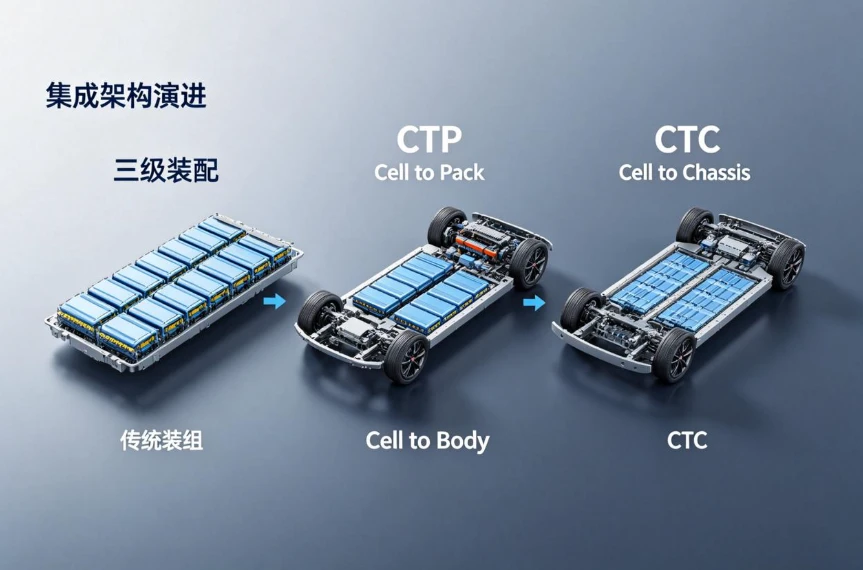
III. Battery Pack Integration Technology: From "Three-Level Assembly" to "Zero-Level Integration"
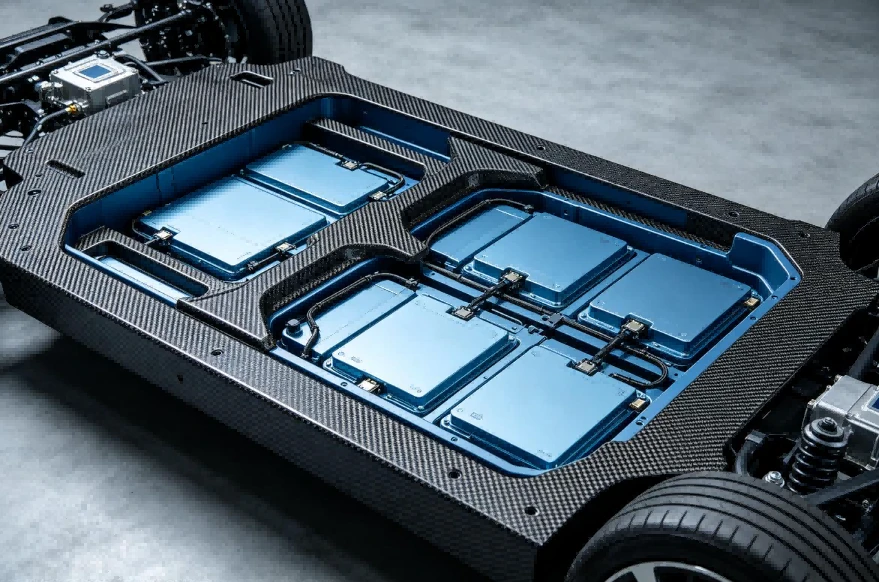
The architectural differences between NEVs and conventional fuel vehicles have given rise to a brand-new landscape for composite-material applications.
(Figure / Source: CCIA)
NEV design brings major changes fundamentally different from those of fuel vehicles, manifested in four dimensions:
|
Dimension |
Specific Components |
|
Disappearing components |
Composites demand for engines and intake/exhaust systems drops to zero |
|
Added components |
Battery pack, e-drive, power electronics, thermal management, frunk |
|
Structural reconfiguration |
Body floor, sill, and longitudinal-beam load paths changed |
|
New safety requirements |
High-voltage electrical safety, battery crash protection, thermal-runaway blocking |
NEVs' lightweighting needs differ essentially from those of fuel vehicles. First, the weight-reduction logic differs. Every 100 kg reduction in an NEV's curb weight lowers power consumption per 100 km by about 0.6–1.0 kWh, translating (under NEDC) to roughly 5%–7% range improvement; moreover, the NEV battery pack itself weighs 500–700 kg, creating for composites a unique value in battery-pack enclosure applications distinct from the fuel-vehicle case. Second, functional-integration needs. NEVs eliminate the traditional internal-combustion engine, freeing the front compartment into a frunk-a use case rare in most fuel vehicles-so composite suppliers need not face cost competition from mature metal-stamping processes. Third, divergence between Chinese and European/U.S. routes. The Chinese market is oriented toward low cost and large-scale production; composite applications lean toward glass-fiber-reinforced thermoplastics (e.g., SMC, LFT-D), with per-vehicle composite usage concentrated in the 20–40 kg range. On carbon-fiber raw materials, China's 2025 carbon-fiber output was 87,200 tonnes, with operating capacity 171,000 tonnes (52.5% of global), domestic demand 132,000 tonnes, of which domestic-fiber supply was 113,400 tonnes (85.9% localization rate, imports falling to about 14.1%), with supply also including some release of earlier inventory-yet high-end segments remain import-dependent. The European market places more emphasis on carbon-fiber composite applications in high-end models and the compliance of bio-based / recyclable materials.
The most symbolic change in 2026 comes from the technology-route landscape of power-battery exports. In the first half of 2026, China's LFP power-battery exports surpassed ternary batteries for the first time in history. This reversal stems from the iteration of overseas NEV model structures-previously overseas markets were dominated by high-end long-range models using high-energy-density ternary batteries; as Chinese brands export LFP models at scale to Southeast Asia, Latin America, and Europe, the LFP route is moving from China-led to global diffusion.
Solid-state batteries are the most-watched next-generation battery technology of 2026. 2025 was defined by the industry as the first year of semi-solid-state battery industrialization; all-solid-state pilot lines have been built and commissioned. BYD's released sulfide all-solid-state battery achieves a single-cell energy density of 400 Wh/kg (claimed value), over 1,200 km CLTC-range, 5C ultra-fast charging, and retains above 80% discharge capability at −30°C. On September 3, 2026, at the 2026 World Power Battery Conference (Yibin), Chery Holding chairman Yin Tongyue announced the Rhino solid-state cell at 400 Wh/kg, with a solid-liquid hybrid version planned for vehicle installation in Q4 2026 and all-solid-state planned for on-vehicle verification in 2027. Liquid batteries will still cover mainstream demand below 300 Wh/kg; over the next 3–5 years solid-liquid hybrid batteries are expected to enter commercial application first (mainly in mid-to-high-end models), while all-solid-state will achieve energy densities above 500 Wh/kg. Academician Ouyang Minggao of the Chinese Academy of Sciences pointed out: "We will move from today's liquid lithium-ion batteries to solid-liquid hybrid batteries, and then to all-solid-state batteries-this is a route we must take." For the composites industry, if all-solid-state batteries achieve scaled mass production around 2030, with smaller cells and lower thermal-management load, pack design will become more compact and the weight-reduction value of composite upper covers will be further amplified-all-solid-state packs can exceed 400 Wh/kg, but because solid-state cells are vibration-sensitive, requirements for the composite enclosure's vibration damping and energy absorption actually rise.
The battery-pack integration architecture is evolving "from three-level assembly to zero-level integration," and China leads the world in this evolution. The significance for the composites industry is that each eliminated intermediate structural level releases a batch of "metal parts" awaiting redefinition of their material. CTP eliminates the module frame, giving module end-plates and side-plates the chance to be replaced by glass-fiber-reinforced PA6/PA66 injection-molded parts; CTB upgrades the battery upper cover into the body floor, opening the door for continuous-fiber-reinforced composites to enter the body-structure domain; CTC fuses the battery with the chassis, and the route contest between integrated die-cast aluminum and composites will enter its most intense stage. The traditional three-level architecture has about 40%–50% volume utilization. CTP removes the module level-CATL's Qilin CTP 3.0 reaches 72% volume utilization. CTB uses the pack upper cover directly as the body floor; BYD's Seal system utilization rises to 66%. CTC further abolishes the "battery pack" concept; Tesla's 4680 Model Y reaches 75% space utilization.
IV. Battery Pack Material System Selection
For the composites industry, the higher the integration, the more fundamentally the pack's requirements for enclosure materials change. First, structure–function integration: in CTB/CTC the battery upper cover simultaneously bears body-floor structural function, so SMC's flexural modulus is insufficient and it must be upgraded to organosheet. Second, sealing–safety integration: integrated composite molding reduces leakage paths. Third, thermal-management coupling: after CTP/CTB remove the module insulation layer, the thermal-runaway propagation time window shrinks from minutes to seconds, requiring the upper cover and tray to simultaneously provide the triple function of "insulation + flame retardancy + thermal barrier." From a cost-transmission view, CTP/CTB reduce part counts, raising per-vehicle composite usage from about 20–40 kg under the traditional architecture to about 50–80 kg under CTB. But integrated architectures demand higher forming consistency and yield; in competitive comparison, integrated die-cast aluminum and composites form direct competition in the CTB upper-cover domain. Die-cast aluminum is low-cost and thermally conductive, but has low shape freedom, cannot integrate insulation/flame-retardant functions, and is heavy. Die-cast aluminum still dominates today, but composites are accelerating penetration in the European market (driven by ELV-R) and in high-end models.
The group standard T/CPQS A0065-2026 "Safety Requirements and Test Methods for Traction Battery Systems of Electric Vehicles over Their Operating Life Cycle," released by China Automotive Technology and Research Center (CATARC) in 2026, systematically covers for the first time battery safety testing "from new to old" across the full life cycle, meaning that the strength-retention rate and flame-retardant-property degradation of aged composite components will indirectly become key considerations affecting product market access.
|
Application Area |
Specific Components |
Common Materials |
|
Battery system |
Battery pack upper cover |
Short-glass-fiber PA66-GF, SMC, organosheet |
|
Battery tray / bottom plate |
Hybrid solutions, GMT, LFT-D |
|
|
Battery underbody protection plate |
Continuous-glass-fiber thermoplastic sandwich |
|
|
Battery enclosure (integral) |
Continuous-glass-fiber reinforced thermoplastic |
|
|
Battery disconnect-switch housing |
Glass-fiber-reinforced V0 flame-retardant PA66/6 |
|
|
E-drive system |
Inverter cover / housing |
organosheet |
|
Motor rotor sheath |
Carbon-fiber filament winding |
|
|
Body structure |
Frunk |
Glass- / carbon-fiber-reinforced thermoplastic |
|
Body floor (CTB integration) |
Continuous-fiber-reinforced composite |
|
|
Interior & periphery |
Instrument-panel carrier, door inner panel |
PP-LGF, flax-fiber-reinforced PP |
|
Thermal-management system |
HVAC housing, evaporator housing |
Glass-fiber-reinforced PA66/PPS |
V. Divergence in International Standards
The NEV battery-safety standard systems of the world's major markets underwent major updates in 2026: China's GB 38031-2025 entered formal implementation, the EU ELV-R was formally legislated, and the EU Battery Regulation's carbon-footprint labeling became mandatory. The differences and coordination among these three systems directly affect the design inputs and certification costs of composite battery enclosures.
China's GB 38031-2025 "Safety Requirements for Traction Batteries of Electric Vehicles" was formally implemented on July 1, 2026 for newly type-approved models, with already-approved existing models deferred to July 1, 2027. Approved and released by the State Administration for Market Regulation and the Standardization Administration on March 28, 2025 and developed under MIIT, the new standard comprises 7 cell tests and 17 pack-or-system tests, covering industry-consensus safety-risk scenarios for traction batteries. Compared with the 2020 edition, core revisions include: (1) upgraded thermal-propagation test-changing the original requirement of "providing a thermal-event alarm signal 5 minutes before fire or explosion" to "no fire, no explosion (alarm still required), and smoke must not harm occupants," stricter than the U.S. FMVSS 305a and UN ECE R100 (which focuses on electrical safety); (2) new post-fast-charge-cycle safety test-requiring "no fire, no explosion" when passing the external-short-circuit test after 300 fast-charge cycles, aimed at addressing safety challenges from fast-charging proliferation; (3) new bottom-impact test-assessing safety protection after the battery bottom is struck; (4) further clarified technical requirements for test-battery temperature, power-on/off states, observation time, and whole-vehicle test conditions. Notably, the standard fully adopts the coordination outcomes of international standards such as UN R100, UN GTR 20, ISO 6469-1, IEC 62660-2, and IEC 62660-3, to facilitate international trade.
For the composites industry, the tightening of GB 38031-2025 directly benefits composite battery upper covers with the triple function of insulation, flame retardancy, and thermal insulation-metal enclosures lack insulation and require an additionally installed insulation sheet, whereas composite enclosures can integrate insulation with structural function. Specifically, GB 38031-2025 requires the pack to show no fire and no explosion after thermal runaway, meaning the upper-cover material must maintain structural integrity for at least 5 minutes under high-temperature flame impingement; composite (especially flame-retardant-agent-added SMC or thermoplastic PA) fire resistance must pass dedicated burning tests. Composite solutions typically adopt a three-layer structure of "SMC upper cover + mica insulation layer + intumescent flame-retardant coating": the SMC body provides structural strength, the mica layer provides fire-resistant insulation, and the intumescent coating forms a char layer at high temperature to block heat. This composite structure raises upper-cover material cost versus single-layer SMC, but compared with metal aluminum covers that require 2–3 additional insulation pads, system cost remains competitive.
The EU circular-economy regulation reached a legislative milestone in 2026. The EU's new ELV-R was formally published in the Official Journal on July 24, 2026 as "Regulation on circular-design requirements for vehicles and end-of-life vehicle management" (EU) 2026/1738, replacing the original ELV Directive (2000/53/EC) and the End-of-Life Vehicles RRR Directive (2005/64/EC), and amending related regulations; it entered into force on August 13, 2026 and will be applied from September 1, 2028. The new regulation introduces for the first time mandatory recycled-plastic-content requirements: within six years of entry into force new-vehicle plastics must contain 15% recycled plastic, and within ten years 25%, of which at least 20% must come from closed-loop end-of-life-vehicle recovery. By the July 2026 publication date, the 15% target is roughly reached around 2032 and the 25% target around 2036, giving composite enterprises about a six-year transition to complete bio-based / recycled-material production-line upgrades and certification.
Regarding the EU Battery Regulation (EU 2023/1542, in force since August 17, 2023), 2026 entered a period of intensive implementation: (1) the carbon-footprint label entered full mandatory implementation on August 18, 2026, requiring EV batteries to declare carbon-footprint information; (2) the Battery DPP (Digital Product Passport) registration system went live on July 20, 2026 (including test environment, technical documentation, and help desk), with implementing Regulation (EU) 2026/1778 adopted July 16 and in force August 6, 2026, specifying technical requirements for registration, verification, identifiers, API, and access management; (3) the DPP digital passport becomes mandatory on February 18, 2027, recording battery material composition, recycled content, carbon footprint, and recycling path; (4) mandatory recycled-content targets continue-16% cobalt / 6% lithium / 6% nickel from 2031, rising to 26% cobalt / 12% lithium / 15% nickel by 2036. The EU also requires exporting enterprises to bear full end-of-life battery recycling responsibility through an extended-producer-responsibility system; most Chinese enterprises without an EU entity must entrust local authorized bodies to fulfill it.
The EU ELV-R (EU) 2026/1738 and the Battery Regulation's carbon-footprint labeling have especially far-reaching impact on the composites industry. This regulation directly drives multiple composite innovations mentioned in the JEC report: RadiciGroup's recycled-glass-fiber PA6 battery modules, Cathay Biotech + Pentaxia's bio-based polyamide battery top covers, MBHA Group's recycled-carbon-fiber + bio-based-resin battery covers, and Swancor's 50% recycled-carbon-fiber recyclable SMC-all direct responses to ELV-R. From a compliance-pathway view, composite enterprises have three strategies against ELV-R: first, use recycled fibers (rCF, rGF) to replace virgin fibers; second, use bio-based resins (bio-based PA, bio-based benzoxazine) to replace petrochemical resins; third, design detachable / depolymerizable structures to support closed-loop recycling-Swancor's EzCiclo/CleaVER chemical-recycling system is a representative of the third path. On compliance progress, RadiciGroup launched PA6 battery-module samples with 30% recycled glass fiber in 2025; Cathay's bio-based PA56 battery top cover has passed EU REACH registration; Swancor's 50% recycled-carbon-fiber SMC has obtained its first customer certification in Europe. China builds a dual-track recycling system via the "End-of-Life Vehicle Recycling Management Measures" (State Council Decree No. 715) and the "Interim Measures for the Recycling and Comprehensive Utilization of Retired NEV Power Batteries" (Six-Department Decree No. 73, effective April 1, 2026), but has not yet set mandatory recycled-content ratios for new-vehicle materials, leaving a regulatory gap of about 5–10 years versus the EU.
From a certification-economics perspective, a composite battery enclosure that simultaneously passes China's GB, the EU's CE/UN ECE, and the U.S. UL certifications typically requires a 12–18 month certification cycle, posing a significant market-entry barrier for small and medium composite enterprises. After DPP implementation, although the composite battery enclosure is not the battery itself, as a pack component it must also declare material composition and recyclability, requiring composite suppliers to build a material-traceability system (ERP + batch management); SMEs must consider IT-upgrade costs. On international-standard coordination, the three systems-China's GB 38031-2025, UN ECE R100 Rev.3, and U.S. FMVSS 305a-are gradually converging under the IEC framework, but divergences remain on thermal-runaway testing: China requires no-fire/no-explosion, UN R100 Rev.3 requires only a 30-minute alarm, and U.S. FMVSS 305a does not yet mandate thermal-runaway testing. China is actively participating in international standard-setting, having led the development of 7 NEV international standards covering whole vehicles and batteries, including the newly proposed ISO/AWI TS 25344-1 (Test methods for thermal-management systems of traction battery packs and systems - Part 1: General tests) and ISO/AWI TR 25344-2 (Part 2: Liquid-cooling/thermal systems), providing an institutional channel for Chinese composite enterprises to engage in international standard-setting.
[To be continued: Composite Materials Applications in New Energy Vehicle Battery Enclosures (Part 2)]
Article Source
Source: Official website of the China Composites Industry Association (CCIA)
Original Link: https://www.ccia.xin/xingyebaogao/3712.html