


[Continued from: Development and Trends of Carbon Fiber Composites in Sports and Leisure (Part I) (1)]
3.1 Autoclave Molding: The "Gold Standard" for Top Competition Equipment
Autoclave molding delivers the highest quality - and the highest cost - among carbon fiber molding processes, with product porosity below 1% and mechanical properties close to theoretical limits. In sporting goods, nearly all top-level competition equipment uses it: flagship road bike frames such as the Trek Madone and Specialized S-Works Tarmac use Toray T800/T1000-grade prepreg cured at 120–180 °C and 5–7 bar for 2–4 hours, with a frame weight of only 700–800 g; high-end golf shafts from Fujikura and Graphite Design use Toray T1100G carbon fiber prepreg with autoclave curing to balance extreme stiffness and light weight; America's Cup sailing components are also autoclave molded for maximum reliability. Equipment investment typically runs RMB 20–50 million and unit cost is very high, limiting the process to top-tier competitive products.
3.2 Filament Winding: The "Soul Process" for Fishing Rods and Golf Shafts
Filament winding is one of the most heavily used molding processes for carbon fiber sporting goods and is irreplaceable in fishing rods and golf shafts. Resin-impregnated carbon fiber tows are wound onto a mandrel at precise angles - inner layers at small angles (15°–25°) provide bending stiffness, outer layers at large angles (45°–60°) provide torsional stiffness - so that multi-angle lay-up design optimizes the anisotropic mechanical performance of the product.
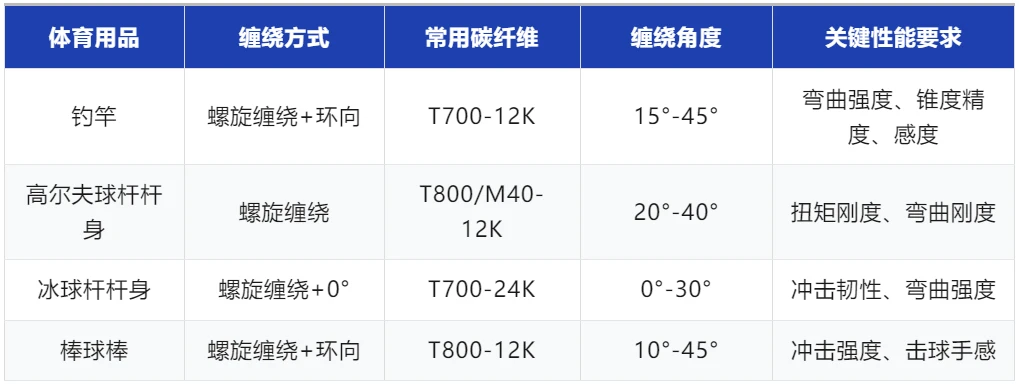
Weihai Guangwei Composites started exactly here, with fishing rod filament winding. In 1998 it imported China's first wide-width carbon fiber prepreg line to serve rod manufacturing, then extended upstream into carbon fiber materials, eventually becoming a full-chain leader in China's carbon fiber industry. Its carbon fiber prepreg remains the core raw material of the Weihai fishing tackle cluster. Weihai, the world's largest fishing rod manufacturing center, hosts a complete chain running from carbon fiber prepreg → filament winding → rod manufacturing → component processing → brand marketing, and accounts for about 60% of global rod output.
3.3 Compression Molding: The "Mass-Production Tool" for Rackets and Carbon Shoe Plates
Compression molding places prepreg into a metal mold and cures it under heat and pressure, offering high efficiency, good precision and suitability for large-batch production. In sporting goods, tennis and badminton racket frames are almost entirely made by prepreg compression molding - the carbon fiber lay-up angle (0°/±45°/90°) controls the racket's bending and torsional stiffness, optimizing the "sweet spot". High-end rackets from Yonex, Li-Ning, Wilson and Babolat all use Toray carbon fiber prepreg with compression molding.
Carbon plates for sports shoes are also compression molded in medium to large batches - several layers of carbon fiber prepreg are cured under heat and pressure in a mold and then cut into sole plate shapes. Carbon-plated running shoes from Nike, Li-Ning, Xtep and Anta all use this process. Bicycle components (stems, seat posts, cranks), ski bindings and protective gear shells are also widely compression molded; brands such as Giant and Merida use large numbers of compression-molded carbon parts.
3.4 RTM and VARI: From Bicycle Rims to Racing Boat Hulls
RTM (Resin Transfer Molding) uses a closed mold with pressurized resin injection to achieve smooth surfaces on both sides and near-net-shape production. In sporting goods, RTM is mainly used for carbon fiber bicycle rims (one-piece molding reduces the number of joints), golf club heads (high-precision forming of complex geometries) and ice hockey stick shafts (variable wall thickness for light weighting). Compared with the prepreg–autoclave route, RTM raises production efficiency by 3–5 times.
VARI (Vacuum Assisted Resin Infusion) uses vacuum negative pressure to drive resin into dry fiber; equipment investment is low and the process suits large parts. In sporting goods, VARI is mainly used for rowing shells, kayaks and sailing hulls (3–10 m in size, too large for an autoclave). A well-known European kayak brand uses VARI to produce competition-grade carbon fiber kayaks, cutting the cycle time per unit from 40 hours with hand lay-up to 12 hours and reaching a fiber volume fraction of 58%. Carbon fiber surfboards and stand-up paddle boards (SUP) also use VARI; its low-pressure forming successfully integrates EPS foam cores with carbon fiber skins, making the products 30% lighter than conventional glass fiber surfboards.
3.5 Prepreg: The "Core Intermediate Material" of Sporting Goods Manufacturing
Prepreg is the most important intermediate material in CFRP manufacturing - a semi-cured sheet produced by pre-impregnating carbon fiber with resin. In sporting goods, thermoset prepreg (mainly epoxy) accounts for about 80% and is widely used in bicycle frames, golf shafts, tennis rackets and fishing rods; thermoplastic prepreg (PEEK, PPS, PA6 and others) accounts for about 20% and is growing rapidly - its recyclability, re-processability and short molding cycle (minutes versus hours) particularly suit skis, protective gear and carbon shoe plates, where toughness and productivity matter most. Teijin operates a thermoplastic unidirectional tape plant in Germany dedicated to carbon fiber/PEEK and carbon fiber/PPS prepreg for sporting goods.
4. Material Comparison: Why Has Carbon Fiber Become the First Choice for Sporting Goods?
The core demand in material selection for sporting goods is "lighter, stronger, more resilient, more durable". Carbon fiber shows overwhelming advantages across all four dimensions:
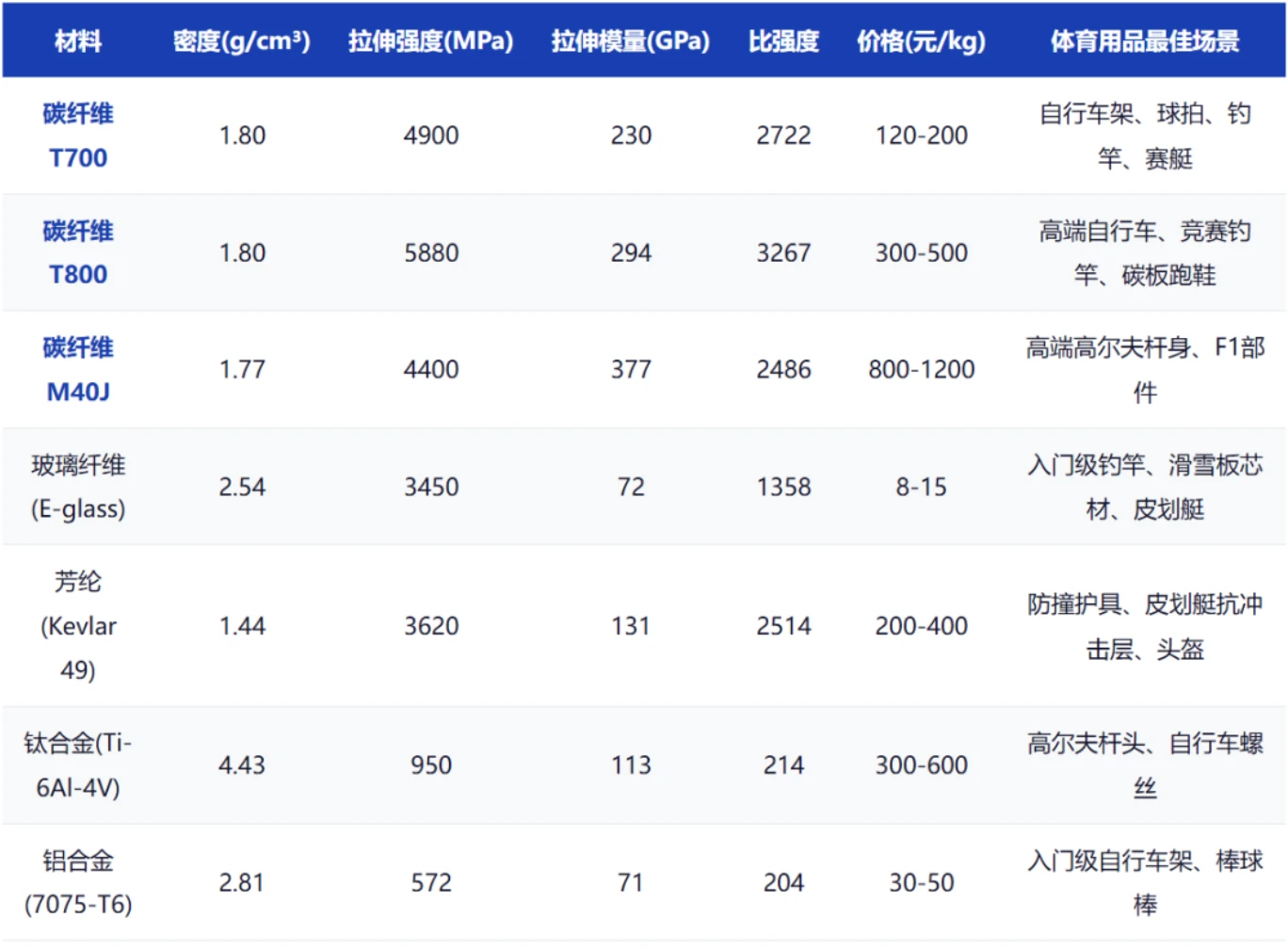
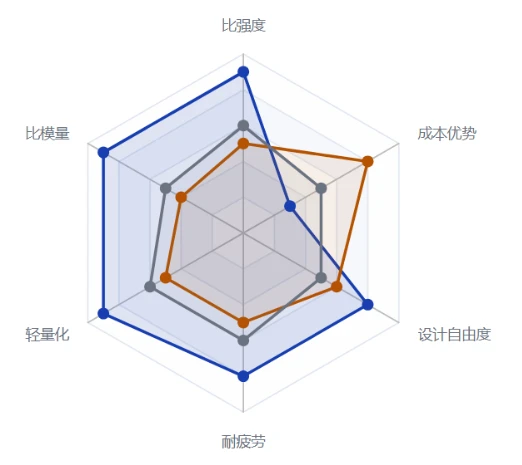
The specific strength (strength/density) of carbon fiber is 10 times that of steel, 8 times that of aluminum alloy and 5 times that of titanium alloy - exactly the combination of extreme lightweight and high strength that sporting goods pursue. But carbon fiber is not a universal answer: its brittleness means catastrophic failure can occur under severe impact, so in ice hockey sticks, ski edges and other applications requiring high toughness, carbon/aramid hybrid weaving is often adopted, using the excellent impact resistance of aramid to offset the brittleness of carbon fiber. Shimano's high-end EXSENS rod series uses a carbon fiber plus aramid hybrid, significantly improving impact toughness while keeping weight down.
On cost, large-tow carbon fiber (48K/50K) has fallen to RMB 80–100/kg, continually narrowing the gap with glass fiber (RMB 8–15/kg). The rapid release of large-tow carbon fiber capacity by Jilin Chemical Fiber Group is accelerating carbon fiber's move from professional competition into mass consumer markets. Taking carbon fiber bicycles as an example, the use of large-tow carbon fiber can cut frame material cost by about 40%, bringing entry-level carbon bicycle prices down from RMB 8,000 to the RMB 5,000 range.
5. Core Applications: How Carbon Fiber Is Reshaping the Sporting Goods Landscape
5.1 Golf Clubs: Carbon Fiber's "First Battlefield"
Golf clubs are the largest single sports application market for carbon fiber. When carbon fiber was commercialized in the 1970s, golf clubs and fishing rods were among the first sporting goods to adopt it. According to QYResearch, global sales of carbon fiber golf clubs are expected to reach RMB 5.854 billion by 2031, a compound annual growth rate of 7.0%.
On the technology side, the TaylorMade Qi10 LS driver uses the "Infinity Carbon Crown" design with 60 layers of carbon fiber and a double-curved face, with carbon covering 97% of the crown area to achieve excellent energy transfer efficiency. Graphite Design's Tour AD series shafts use Toray T1100G carbon fiber prepreg and nano-alloy technology, greatly increasing structural stiffness without adding weight. Callaway (annual revenue of about USD 1.8 billion) and TaylorMade (about USD 1.5 billion) are the two leading global brands in carbon fiber golf clubs, and both source their core carbon fiber materials exclusively from Japan's Toray.
It is worth noting that carbon fiber materials for China's high-end carbon fiber golf clubs are up to 87% import-dependent, leaving huge room for domestic substitution. The development path of Guangwei Composites - starting from Weihai fishing tackle and gradually extending upstream into carbon fiber materials - offers a replicable model for the industry: start from end-market sporting goods demand, integrate upstream materials in reverse, and close the loop of the industry chain.
[To be continued: Development and Trends of Carbon Fiber Composites in Sports and Leisure (Part I) (3)]
[Source] China Composites Industry Association (CCIA), official website
[Original link] https://ccia.xin/xingyebaogao/3618.html