


I. Visual inspection
Visual inspection is the primary inspection method for in-service inspection. Most types of damage will burn, contaminate, dent, penetrate, abrade, or chip the surface of the composite, making the damage visible. Once damage is detected, the affected area needs to be examined more closely using flashlights, magnifiers, mirrors, and pipe mirrors. These tools are used to magnify defects that may not otherwise be readily visible and allow visual inspection of areas that are not readily apparent. Resin deficiencies, resin excesses, wrinkles, adhesive ply spans, discoloration (due to overheating, lightning strikes, etc.), impact damage from any cause, foreign objects, blisters, and debonding are all differences that can be detected by visual inspection. Visual inspection cannot detect internal defects in composites such as delamination (delamination), bulk and matrix cracking. More sophisticated NDI techniques are required to detect these types of defects.
II. Sound testing (metal tapping)
Sometimes referred to as audio, sonic or tapping, this technique utilizes frequencies within the audible range (10hz to 20hz). In the hands of experienced personnel, the tap test is an amazingly accurate method and is probably the most common technique used to detect delamination and/or debonding. The method is accomplished by tapping the inspection area with a solid circular or lightweight hammer-like device and listening to the structure's response to the hammer. As shown in Figure 24, a clear, sharp, ringing sound indicates a well-bonded structure, while a dull or thump-like sound indicates areas of discrepancy.
The rate of tapping needs to be fast enough to produce a sufficient number of sounds for the ear to be able to distinguish any differences in timbre. The tap test is effective for thin laminates reinforcing bond lines, honeycomb interlayers with thin panels, and even near the surface of thick laminates such as rotor blade supports. Again, inherent in this method is the possibility that variations in the internal elements of the structure may produce pitch variations that are interpreted as defects, when in fact they appear by design. This inspection should be accomplished in as quiet a location as possible and by experienced personnel familiar with the internal configuration of the part. This method is unreliable for structures with more than four layers. It is often used to mark damage on thin honeycomb panels. As shown in Figure 24.

Figure 24: Tap test with a conical hammer
III. Automatic Tap Test
This test is very similar to the manual tap test in that it uses a solenoid rather than a hammer. The solenoid produces multiple impacts in a single area. The tip of the impactor has a transducer that records the force and time signals from the impactor. The amount of force depends on the impactor, the impact energy and the mechanical properties of the structure.
The impact duration (period) is insensitive to the magnitude of the impact force; however, this duration varies with the stiffness of the structure. Therefore, a signal from a defect-free region is used for calibration, and any deviation from this defect-free signal indicates the presence of damage.
IV. Ultrasonic inspection
Ultrasonography has proven to be a very useful tool for detecting internal delamination, voids, or inconsistencies in composite assemblies that otherwise could not be recognized by visual or percussive methods. There are many ultrasonic techniques; however, each technique uses sound wave energy at frequencies above the audible range. As shown in FIG. 25, high-frequency (typically a few megahertz) sound waves are introduced into a component and may propagate directionally to the surface of the component, either along the surface of the component, or at a predetermined angle to the surface of the component. You may need to try different directional flows to orient yourself. The introduced sound will then be monitored when any significant change in its designated route through the part is made. Ultrasonic waves are similar in nature to light waves. When an ultrasonic wave strikes an interrupted object, the wave or energy is either absorbed or reflected back to the surface. After the interrupted or attenuated acoustic energy is picked up, it is received by a transducer and converted to a display on an oscilloscope or chart recorder. This display allows the operator to evaluate different metrics in comparison to known good areas. For comparison purposes, reference standards have been established and are used for calibration of ultrasound equipment.
Maintenance technicians must recognize that the concepts outlined here work well in repetitive manufacturing environments, but may be more difficult to achieve in a maintenance environment where a large number of different composite components are installed in aircraft with relatively complex structures. The reference standard must also take into account the changes that occur when composite components are exposed to the use environment for extended periods of time or are the subject of repair activities or repair-like maneuvers. The four most common ultrasound techniques are discussed next.

Figure 25: Ultrasonic Inspection Methods
4.1 Transmission ultrasonography
By transmission ultrasonography two transducers are used, one on each side of the area to be examined. The ultrasound signal is transmitted from one transducer to the other. An instrument is then used to measure the loss of signal strength. The instrument expresses the loss as a percentage or decibel of the original signal strength. The signal loss is compared to a reference standard. Areas where the loss is greater than the reference standard indicate defective areas.
4.2 Pulsed-echo ultrasonography
Single-sided ultrasonography can be accomplished with the pulse-echo technique. In this method, a single search unit operates as a transmitting and receiving transducer, excited by high-voltage pulses. Each electrical pulse activates the transducer element. This element converts electrical energy into mechanical energy in the form of ultrasound. The acoustic energy enters the test section through a Teflon (Teflon)® or methacrylate contact tip. A waveform is generated in the test section and picked up by the transducer element. Any change in the amplitude of the received signal, or the time it takes for the echo to return to the transducer, indicates the presence of a defect. Pulse echo testing is used to detect delamination, cracks, porosity, water and debonding of bonded parts. Pulse echo did not detect bond debonding or defects between the sandwich skin and the honeycomb core. As shown in Figure 26.

Figure 26: Pulse-echo test equipment
4.3 Ultrasonic bond tester
Low and high frequency bond testers are used for ultrasonic inspection of composite structures. These bond testers use inspection probes with one or two transducers. The high frequency bond tester is used to detect delamination and voids. It does not detect surface-to-cellular core debonding or porosity. It can detect defects as small as 0.5 inches in diameter. This low frequency bond tester tester uses two sensors to detect delamination, voids, and peeling of the honeycomb core. This inspection method does not detect which side of the part is damaged and cannot detect defects smaller than 1.0 inch. As shown in Figure 27.
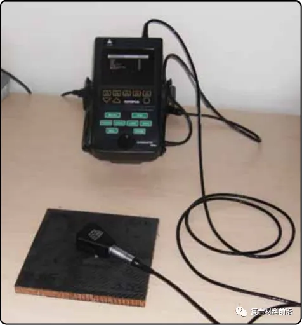
Figure 27: Bonding Tester
4.4 Phased Array Inspection
Phased array inspection is one of the latest ultrasonic inspection methods for detecting structural defects in composites. It operates on the same principle as pulse-echo, but it uses 64 transducers simultaneously, which speeds up the inspection process. As shown in Figure 28

Figure 28: Phased Array Test Equipment
V. Radiographic Inspection Methods
Radiography, often referred to as x-rays, is a very useful NDI method because it essentially allows access to a view of the inside of the part. This inspection method involves passing x-rays through the part or assembly being tested while recording the absorption of the rays on x-ray sensitive film. Exposure of the film, when developed, allows the inspector to analyze the changes in exposure opacity recorded on the film, in effect creating a visualization of the relationship of details within the component. Because the method records changes in total density through its thickness, it is not the preferred method for detecting defects such as delamination in a plane perpendicular to the direction of the rays. However, it is the most effective method for detecting defects parallel to the centerline of the x-ray beam. Internal anomalies such as delamination in corners, crushed cores, broken cores, water in core cells, voids in foam adhesive joints, and the relative position of internal details can be easily seen by x-ray film. Most composites are nearly transparent to x-rays, so low-energy rays must be used. For safety reasons, it is impractical to use them around airplanes. Operators should always be protected with adequate lead shields, as direct contact with either the x-ray tube or scattered radiation is possible. Maintaining a minimum safe distance from x-ray sources is essential.
VI. Thermal fusion inspection
Thermal inspection includes all methods of measuring the temperature change of a part under test with a thermal sensing device. The basic principle of thermal inspection consists of measuring or gauging the surface temperature as heat flows out of, into, or through the test object. All thermal imaging techniques rely on the difference in thermal conductivity between normal, defect-free areas and defective areas. Typically, a heat source is used to raise the temperature of the part under test when observing surface heating effects. Because areas without defects conduct heat more efficiently than areas with defects, the amount of heat absorbed or reflected indicates the quality of the bond. Types of defects that affect thermal performance include bonding, cracking, impact damage, panel thinning, and water ingress into composites and honeycomb cores. The thermal method is the most effective method of detecting thin plywood or defects near the surface.
VII. Neutron Radiography
Neutron radiography is a non-destructive imaging technique that visualizes the internal characteristics of a sample. Neutron transport through the medium depends on the neutron cross section of the nuclei in the medium. The differential decay of neutrons through the medium can be measured, plotted, and then visualized. The resulting image can be used to analyze the internal characteristics of the sample. Neutron radiography is a complementary technique to x-ray radiography. Both techniques visualize the attenuation through the medium. The main advantage of neutron radiography is its ability to reveal light elements such as hydrogen found in corrosives and water.
VIII. Moisture Detectors
A hygrometer can be used to detect moisture in a sandwich honeycomb structure. The hygrometer measures the RF power loss caused by the presence of water. Moisture meters are commonly used to detect moisture in the head radome. comparison of NDI test equipment, as shown in Fig. 29/30.

Figure 29: Humidity test equipment

Figure 30: Comparison of NDI detection equipment